Work / Case study
Seshat: several businesses and a household, in one honest ledger
Month-end became a review instead of a reconstruction — and it can never move a dollar.
An operator running several businesses alongside personal finances was reclassifying the same transactions by hand every month and handing the accountant a scramble every quarter. We built a finance service that reads the accounts, sorts activity to the right entity, and produces something an accountant can actually work from. By design it cannot move money.
The situation
Several legal entities and a household, all with their own accounts, all landing in the same person's lap. Answering "what did this business actually cost me last quarter" meant a day of exports and sorting. The quarterly hand-off to the accountant was a reconstruction from memory. And every tool that offered to fix it wanted the kind of access that can move money out of the account, which was not on the table.
What we built
A finance service built around one hard constraint: it reads, and it can never move anything. It holds no credential that could initiate a transfer, and there is no code path that could try. Within that boundary it does the tedious part — activity comes in, gets sorted to the entity it belongs to, and stays sorted, so the same decision is not made twice. Amounts are held exactly, to the cent, everywhere, because rounding drift in a ledger is not a small bug. It produces organised summaries for the accountant to review, and it is careful to describe them as exactly that: aids for a professional, not filings.
- Read-only by construction — no credential that could move money
- Activity sorted to the right entity and kept that way
- Exact amounts to the cent throughout, no rounding drift
- Accountant-ready summaries, clearly labelled as aids and not filings
- Household and business finances side by side without mixing them
- Sign-in hardened with a second factor
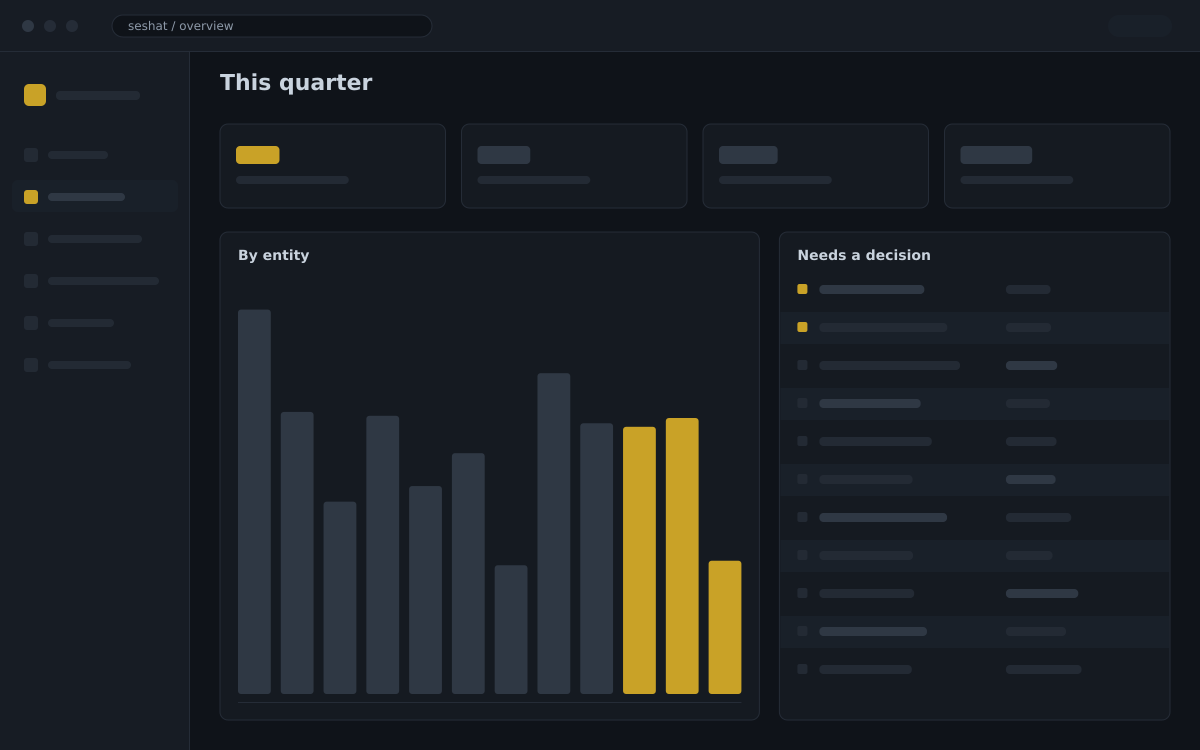

Interface illustrations. Abstracted representations with placeholder content — never client data.
What changed
Month-end is a review of decisions already made rather than an afternoon of sorting. The quarterly hand-off is a report instead of a shoebox. And the thing holding the financial data is structurally incapable of spending any of it.
A structural guarantee, not a policy
Amounts held exactly, everywhere
Something similar on your desk?
Tell us about it. The interview takes about ten minutes and you will hear back from one of the two of us.