Work / Case study
A property acquisition pipeline that keeps every fact about a deal in one record
Research, liens, owner contacts and scoring stopped living in six tools and a spreadsheet.
An investor buying distressed property through seller-financed and assumed-mortgage deals was running research across county records, valuation sites, owner-lookup services and a scoring spreadsheet. We built one record per property that holds all of it, scores the deal on their own criteria, and refuses to pretend a score is trustworthy when half the facts are missing.
The situation
These are not listings you buy off a website. Each one starts as a name and an address and turns into a research job: what is owed, who else has a claim, who actually owns it, can they be contacted lawfully, and does the arithmetic work. That research lived across half a dozen services and a scoring spreadsheet, so the answer to "where are we on this one" depended on who you asked and how recently they had looked.
What we built
One record per property, carrying everything: the research, what is owed and to whom, the owners and how to reach them, valuations, and the deal arithmetic. The scoring engine came straight from the spreadsheet already in use, weights and pass mark included, so the numbers meant the same thing on day one. Two decisions did most of the work. First, a score built on half the facts is shown as provisional and ranked below complete ones, because a confident ten on two known criteria is worse than no score at all. Second, the pipeline advances itself from work actually done rather than from someone remembering to update a dropdown. Contact records carry do-not-call status next to the phone number, where it cannot be missed.
- One record per property holding research, claims, owners and valuations
- Deal scoring on the investor's own criteria and pass mark
- Provisional scores marked and ranked below complete ones
- Pipeline stage inferred from work done, not from a dropdown
- Do-not-call status shown beside every phone number
- Deal paperwork generated from the record rather than retyped
- Map view and directions for a day of driving

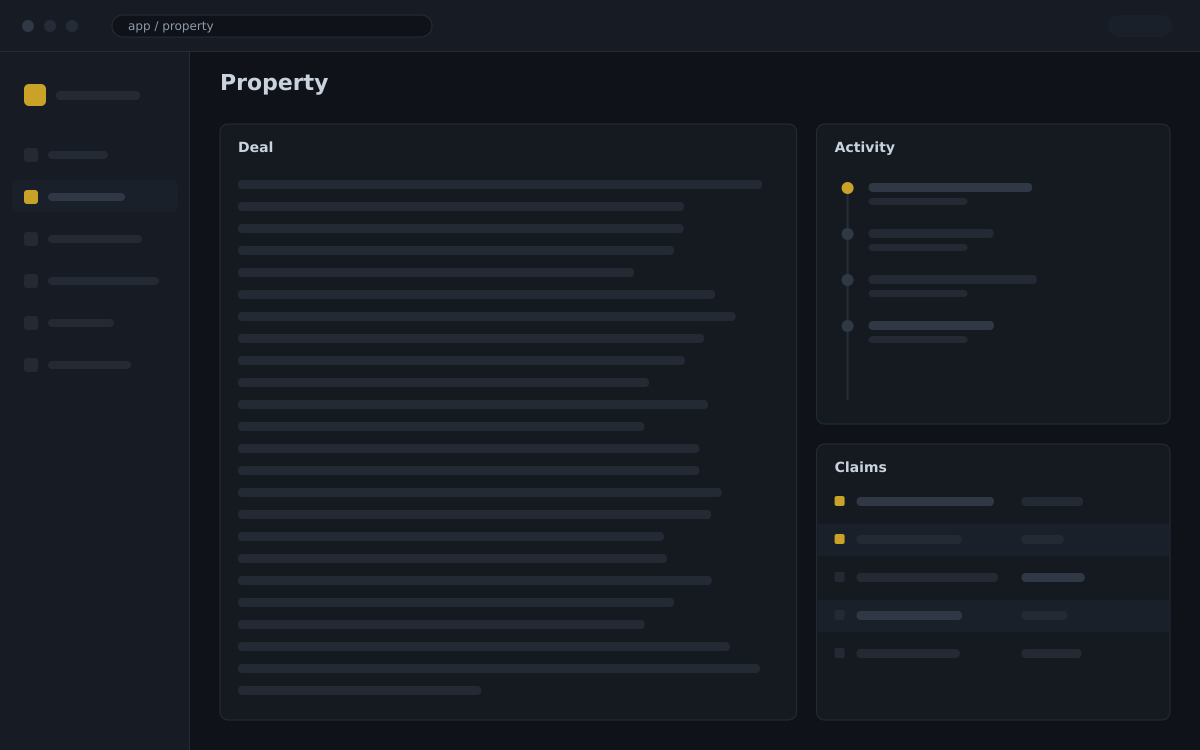
Interface illustrations. Abstracted representations with placeholder content — never client data.
What changed
The state of every deal is a fact rather than a recollection. Scores are trusted because the ones that should not be trusted say so. Paperwork that used to be retyped per deal is generated from the record.
From first look to occupied
Generated from the record on demand
Something similar on your desk?
Tell us about it. The interview takes about ten minutes and you will hear back from one of the two of us.